Digital vs Offset Printing: What’s the Difference and Which Should You Choose?
If you’ve ever gotten a quote for brochures or flyers and wondered why the price per piece drops so much once you order more, the answer usually comes down to one decision: digital vs offset printing. These are the two main ways commercial print jobs get produced, and picking the right one affects your cost, your turnaround time, and — in one important way most people don’t realise — what your finished pieces can actually look like.
At Siang Heng, we run both digital and offset printing in-house, so we don’t have a reason to push you toward one over the other. Here’s how they actually differ, and how to decide which one fits your project.
What Is Offset Printing?
Offset printing works by transferring ink from a printing plate onto a rubber “blanket,” which then rolls the image onto paper. Each colour requires its own plate, and those plates are what get “set up” before the actual printing run begins.
That setup is the key to understanding offset’s cost structure. Making the plates takes time and costs money regardless of whether you’re printing 500 pieces or 50,000 — so the setup cost gets spread across your entire order. Print more pieces, and the cost per piece drops significantly. Print very few, and the setup cost dominates, making it expensive per piece.
What Is Digital Printing?
Digital printing skips the plate-making step entirely. It works more like a high-end office printer — the design is sent directly to the press and printed immediately, with no physical plates involved.
Because there’s no setup cost, digital printing is far more cost-effective for smaller quantities. You’re not paying to “unlock” a printing process before your first piece even comes out. The trade-off is that the cost per piece doesn’t drop as steeply as offset does when you order in bulk.
The Difference Most People Don’t Know: Variable Data
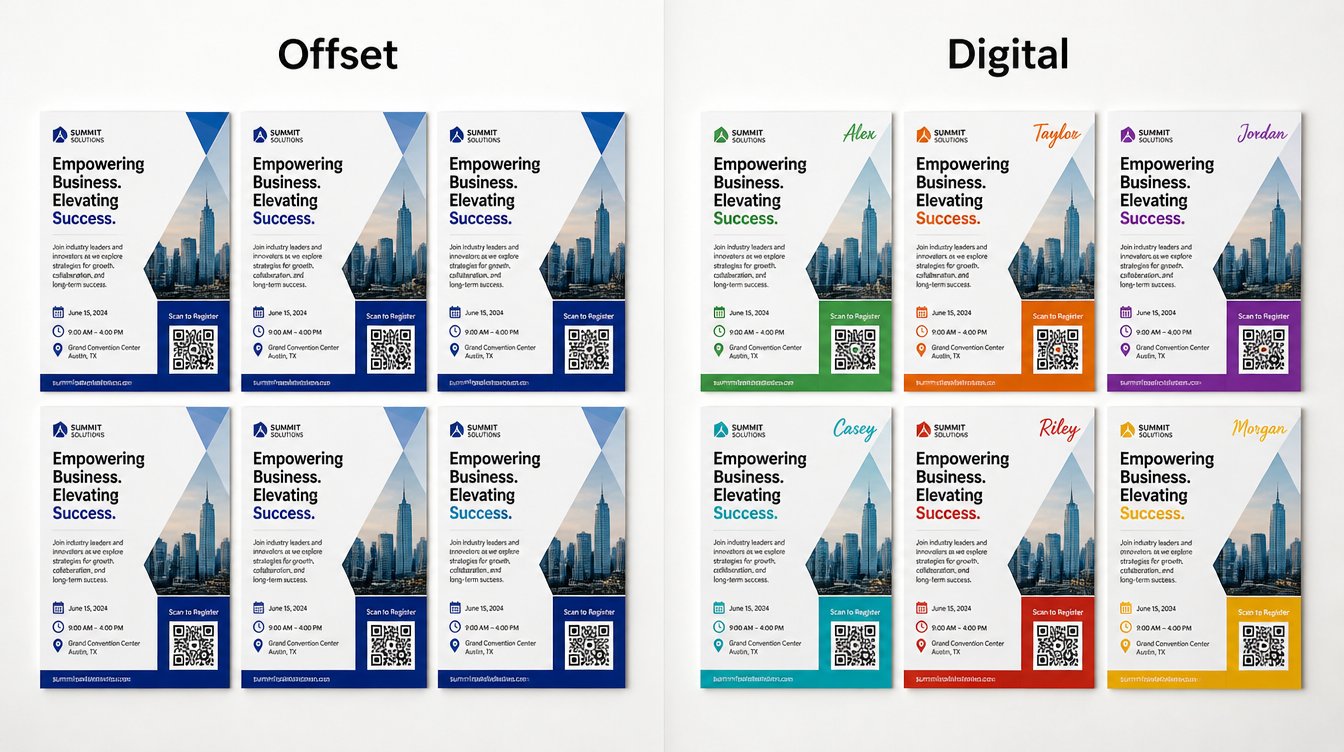
Here’s the distinction that actually matters most for certain jobs, and it has nothing to do with cost. Offset printing uses fixed plates, which means every single piece that comes off the press in one run is identical. The same design, same text, same everything — because the plate itself doesn’t change between pieces.
Digital printing has no such limitation. Because each piece is printed individually rather than pressed from a shared plate, every single piece in a run can be different — different names, different QR codes, different colours, even entirely different layouts — all within the same print job.
This is called variable data printing, and it’s the reason personalised invitations, name-tagged flyers, individually numbered tickets, or campaigns with unique tracking QR codes per recipient are only possible with digital printing. Offset simply cannot do this — it can only ever repeat one artwork many times.
Digital vs Offset: A Practical Comparison
| Feature | Digital Printing | Offset Printing |
|---|---|---|
| Setup Cost | None | Higher, due to plate-making |
| Cost at Low Quantities | More affordable | Expensive per piece |
| Cost at High Quantities | Higher per piece | Much more affordable per piece |
| Personalisation | Every piece can be different | Every piece is identical |
| Turnaround Time | Faster | Longer, due to plate setup |
| Best For | Small runs, fast turnaround, personalised pieces | Large runs of one fixed design |
Which Should You Choose for Your Print Job?
For most of our customers, the decision comes down to two simple questions: how many pieces do you need, and does every piece need to look the same?
Choose digital printing if:
- You’re ordering a smaller quantity (roughly under a few hundred pieces, depending on the product)
- You need a fast turnaround
- You want personalised or variable elements on each piece
- You’re testing a design before committing to a large order
Choose offset printing if:
- You’re ordering in bulk (typically upwards of a thousand pieces)
- Every piece uses the exact same artwork
- You want the lowest possible cost per piece at scale
- Turnaround time is more flexible
We offer both options across our Digital Brochure and Offset Brochure printing, as well as Digital Flyer and Offset Flyer printing, each with an instant price calculator so you can compare the actual cost for your specific quantity before deciding.
Frequently Asked Questions
Is offset printing better quality than digital printing?
Not necessarily. Modern digital printing produces excellent quality that’s suitable for the vast majority of business needs. Offset can offer slightly more colour consistency at very large volumes, but for most print jobs, the two are visually very close.
Can digital printing do large quantities?
Yes, though the cost per piece doesn’t drop as steeply as offset does at scale. If you’re ordering a very large quantity of one fixed design, offset is usually the more cost-effective choice.
Can offset printing do personalised pieces?
No. Offset uses fixed plates, so every piece printed in one run is identical. Personalisation or variable data — such as different names or QR codes per piece — requires digital printing.
What’s the minimum order quantity for offset printing?
This varies by product, but offset generally makes the most financial sense starting from a few hundred to a thousand pieces, depending on the item. Our instant price calculators show the exact cost at every quantity so you can compare directly.
Which is faster, digital or offset printing?
Digital printing is generally faster since there’s no plate-making step involved. If you need a quick turnaround, digital is usually the better choice.
Get an Instant Price for Your Print Job
Whether you need a personalised digital run or a large offset order, Siang Heng has been printing for Singapore businesses since 1986. Browse our brochure and flyer printing options, or get in touch with us if you’re not sure which option fits your project.